For candle brands, the right packaging protects the product and gives customers a clear first impression. Personalized Candle Boxes can be tailored to a candle’s jar size, scent collection, and visual identity. A snug insert may prevent glass jars from shifting, while a well-fitted lid helps the box feel considered when opened. Small details matter.
This guide to China’s top 10 personalized candle box manufacturers is designed to help buyers compare potential suppliers, not simply admire polished product photos. It considers practical points such as customization options, material choices, print quality, sample availability, production communication, and experience handling export orders. Buyers should still confirm specifications directly. A sample can reveal details that a brochure cannot: whether the colors match, the insert holds the jar securely, and the box arrives without crushed corners. Ask about minimum order quantities, lead times, and packing methods before committing.
There is no perfect supplier for every brand. A small studio may value flexible order sizes, while a growing retailer may prioritize consistent production and repeatable finishes. Rankings can also change as capabilities and service evolve. That deserves a second look. Use this overview as a starting point, then compare written quotations and physical samples against your own product requirements. The best choice is the one that protects your candles, represents your brand accurately, and fits your budget without leaving important questions unanswered.
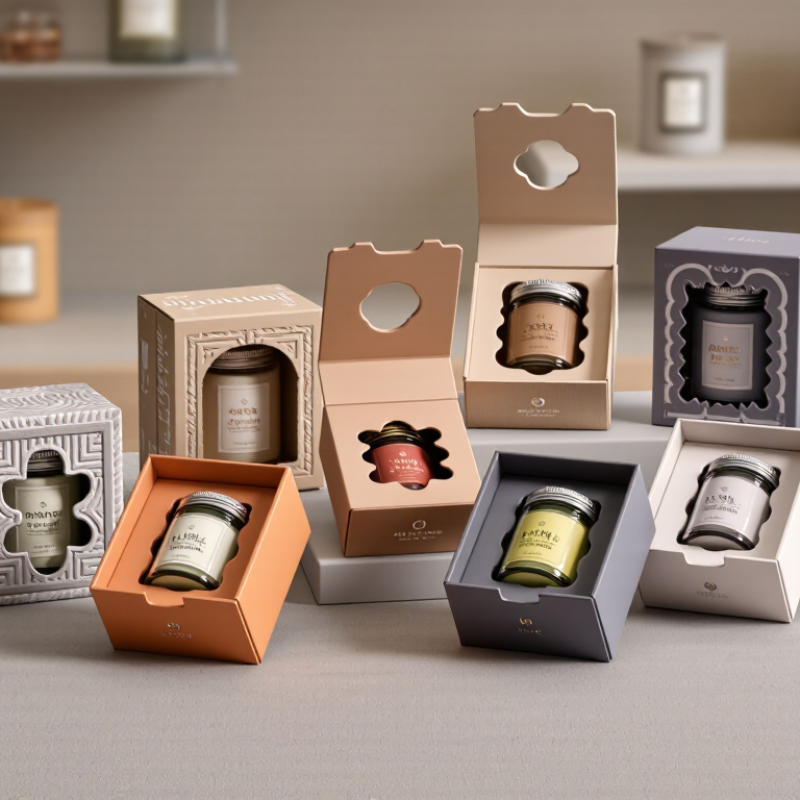
The National Candle Association reports that candles are used in 7 out of 10 U.S. homes. That is a broad measure of household reach, not a count of candles burned each week. Still, it shows how familiar candles are in everyday spaces. A candle may sit on a dining table, beside a bathtub, or on a shelf near the entryway. The packaging often shapes the first impression before the candle is lit.
For manufacturers serving this market, personalized candle boxes need to balance appearance and protection. A snug insert can help limit movement during shipping, while a clear label can make scent and size easy to identify. Color, finish, and opening style can also reflect a gift’s occasion or a retailer’s presentation needs. Small details matter. But decoration alone does not make a box useful.
The 7-in-10 figure should not be treated as proof that every buyer wants elaborate packaging. Preferences vary, and extra finishes can add cost or material. A practical design starts with the candle’s dimensions, weight, and likely route to the customer. Sometimes a simpler box works better. It is worth checking samples by hand; a mock-up may look neat but still feel awkward to open.
| Comparison Dimension | Relevant Data or Specification | What to Confirm with a Manufacturer |
|---|---|---|
| U.S. Candle-Market Context | The National Candle Association reports that 7 out of 10 U.S. households use candles. | Treat this as market context, not as a forecast of demand for any particular candle or packaging product. Source: National Candle Association (NCA). |
| Box Structure | Common paper-packaging structures include folding cartons, rigid boxes, and corrugated shipping boxes. | Ask which structure suits the candle’s weight, fragility, presentation needs, and shipping method. |
| Box Dimensions | Specify internal length, width, and height, usually in millimetres; the required dimensions depend on the candle and any insert. | Confirm whether quoted dimensions are internal or external and request a physical sample for fit checks. |
| Paperboard or Corrugated Material | Material specifications can include paper grade, grammage (g/m²), thickness, and, for corrugated board, flute construction. | Request the exact material specification and confirm that it matches the approved sample and intended use. |
| Custom Printing | Printed packaging may use process colours, spot colours, or a combination, depending on the artwork and print method. | Confirm the print method, proofing process, colour expectations, and whether the quotation includes plates or setup charges. |
| Finishes and Decoration | Possible finishing options include matte or gloss coatings, foil stamping, embossing, and debossing. | Check which finishes are available for the selected material and request a sample showing the chosen combination. |
| Protective Inserts | Inserts can be designed to restrain a candle or container inside the box; their material and layout depend on the product. | Test the packed product for movement and damage risk, especially when the candle is glass or has a separate lid. |
| Prototype and Approval | A dieline defines the box layout for cutting and folding; a production sample can be used to check structure, fit, and artwork. | Approve the dieline and sample before mass production, and document any changes to materials or artwork. |
| Order Quantity and Lead Time | Minimum order quantity and lead time are quotation-specific; they vary with the structure, print method, finishes, and production schedule. | Request written quantities and timelines for sampling and production, including the assumptions used in the quotation. |
| Quality and Sustainability Evidence | ISO 9001 concerns quality management systems. FSC certification applies to specified forest-based products and supply-chain claims; neither should be assumed without evidence. | Verify certificate validity, scope, and applicability to the quoted product. Request relevant inspection records or test reports for the packaging. |
Ask for the test scope, sample photos, and pass-or-fail records. Confirm the report matches your candle and box dimensions.
No. They assess candle burn behavior, stability, or safety labeling. The box itself is not covered by those tests.
It can expose a packed product to drops, vibration, and compression. Test the candle, insert, carton, and void fill together.
A sample reveals lid alignment, insert fit, and print quality. Small details matter.
Not always. A single sample may not reflect later batches, so discuss inspection steps and production tolerances.
Compare structural design, material choices, color matching, and order flexibility. Ask for a sample made from the intended material.
Request clear material specifications and supporting details. Vague wording is not evidence.
Check for cracked glass, wax scuffs, crushed corners, and shifted inserts. Keep notes; problems can be inconsistent.
Candles remain a common household product, with the National Candle Association reporting that they are used in seven out of ten U.S. homes. Choosing suitable packaging starts with the candle’s size, weight, fragility, and presentation needs. Folding cartons offer a lightweight retail option, rigid boxes provide a more substantial unboxing experience, and corrugated shippers help protect orders during transit. Personalized Candle Boxes can combine practical protection with tailored dimensions, finishes, inserts, and printed designs.
This guide introduces ten China-based manufacturers and summarizes the capabilities buyers may wish to assess, including customization options, minimum order quantities, production lead times, certifications, and export readiness. It also explains how relevant benchmarks fit into product and packaging evaluation: ASTM F2417 addresses candle fire safety, ASTM F2058 covers candle fire-safety labeling, and ISTA 3A provides a procedure for evaluating packaged products in parcel delivery conditions. Comparing these factors can help businesses shortlist suppliers and make more informed packaging decisions.

 Momei Printing