Choosing the right Cardboard Soap Boxes manufacturer involves more than comparing prices. Brand owners must examine material quality, printing accuracy, production consistency, and environmental responsibility. A reliable supplier should explain its paperboard grade, recycled content, coating options, and testing process clearly. It should also provide samples before large production begins.
Lynn Dyer, a recognized packaging sustainability specialist, has said, “Packaging should protect the product while using resources responsibly.” This principle matters for soap packaging. A sturdy box should resist dents, moisture, and color fading during storage and transport. However, excessive thickness can increase material use without improving protection. That balance deserves careful thought.
Manufacturers worldwide use different papers, inks, folding structures, and quality controls. Some offer kraft finishes for natural brands. Others produce bright offset printing for retail shelves. Small details matter, including clean creases, accurate dimensions, and secure closure points. Ask about batch inspections and delivery records. Evidence matters more than attractive promises.
This guide introduces leading Cardboard Soap Boxes manufacturers and the strengths they bring to international buyers. It considers customization, minimum order quantities, lead times, certifications, and communication practices. Not every supplier will suit every soap brand. A low-cost option may create hidden problems through weak boxes or inconsistent colors. Even experienced buyers can miss those risks. Careful comparison remains essential.
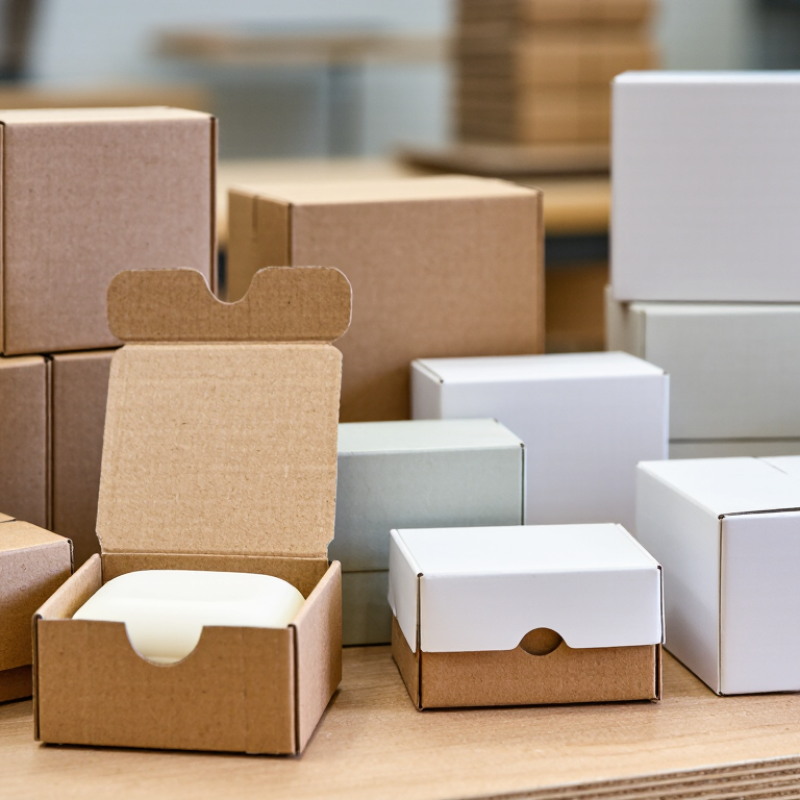
Cardboard soap boxes are folding packages made from paperboard or corrugated cardboard. They protect soap bars from dust, pressure, and rough handling. Their firm panels also create a clean surface for product information and design. In practical packaging work, board thickness affects strength, folding quality, and shelf appearance. A box that feels too thin may crease near the corners. A box that feels too rigid can waste material and resist accurate folding.
These boxes support efficient storage and transport. Flat-packed cartons occupy less warehouse space before filling. After assembly, they hold individual bars securely and reduce surface contact. Many manufacturers use recycled fibers, water-based inks, or recyclable coatings. However, “eco-friendly” should not be accepted without checking material details. Moisture resistance also requires attention, especially in humid bathrooms. Excess coating may affect recyclability, so performance and disposal claims need careful verification.
Tips: Check the soap dimensions before approving a dieline. Leave enough clearance for easy insertion. Test folded samples under pressure and humidity. Inspect print clarity, glue strength, and edge alignment. Do not judge quality by appearance alone. A beautiful box can still open during shipping. Small defects often reveal larger production issues.
Designing a cardboard soap box begins with the product, not the artwork. Manufacturers measure the soap bar, including its length, width, height, and shrink-wrap tolerance. A precise dieline prevents loose corners and difficult assembly. It also reduces material waste.
The chosen board often ranges from 250 to 400 gsm, depending on strength needs. Recycled paperboard supports a natural appearance, while coated board offers sharper color reproduction. Designers test fold lines before approving the final layout. Small adjustments matter. A crease placed too close to an edge can cause cracking.
During manufacturing, sheets are printed, cut, creased, and folded by calibrated equipment. Water-based coatings can improve surface resistance without creating a heavy plastic feel. Operators inspect color consistency, glue coverage, and panel alignment. Drop tests and compression checks reveal weak points before shipment. These practical checks are more reliable than visual inspection alone.
I have found that moisture is often underestimated. Soap packaging may face humid storage rooms or damp bathroom shelves. The box should protect the bar without trapping unnecessary moisture. Still, no design is perfect. A stronger board may increase cost and shipping weight. A glossy finish may look attractive but reduce recyclability. Responsible manufacturers document materials, test results, and production changes. That record helps buyers make informed decisions and correct problems when the first sample is not quite right.
Leading soap box manufacturers distinguish themselves through measurable quality, not attractive catalogs. They use FSC-certified or recycled paperboard, clear material traceability, and low-odor inks. Smithers’ 2024 paper packaging outlook identifies recyclability and fiber efficiency as major purchasing priorities. Strong suppliers also test compression, moisture resistance, folding accuracy, and color consistency before mass production. A box should protect a 100-gram soap bar without excessive material. That balance is easy to miss.
Manufacturing reliability matters equally. Experienced producers provide dieline support, pre-production samples, batch inspection, and documented tolerances. They can adjust board thickness for humid bathrooms or long-distance shipping. The U.S. Environmental Protection Agency reported a 68.2% recycling rate for paper and paperboard containers and packaging in 2018. This figure supports simpler structures and recyclable coatings. However, recycling performance varies by local systems. A glossy finish may look premium, yet it can complicate recovery. No supplier is perfect.
Tips: Request a physical sample before approval. Check fold lines, glue strength, print registration, and inner cleanliness. Ask for recent test records, not general promises. Compare the stated board grade with the delivered sample. A small pilot order can expose weak corners, color drift, or slow communication. These details often reveal more than a polished website.
Comparing cardboard soap box suppliers requires more than checking unit price. The board should protect bars from crushed corners, humidity, and oil transfer. Smithers’ 2024 folding carton market assessment projects steady global growth through 2028, increasing pressure on capacity and lead times. Ask each supplier for board grade, grammage, caliper, recycled content, and verified testing records. Vague answers are warning signs.
Request physical samples, not only digital proofs. Measure panel dimensions, folding accuracy, glue strength, and surface scuffing after handling. ASTM D4169 distribution testing can help simulate shipping stress, while ISO 18606 provides useful guidance for recyclable or compostable packaging claims. Supplier quotes should separate tooling, printing plates, freight, inspection, and rework costs. Cheap is not always economical.
Check production evidence carefully. A 2023 report from Smithers identifies sustainability and fiber efficiency as major folding-carton purchasing factors, so request chain-of-custody documentation and material declarations. Compare minimum order quantities, repeat-order timing, color tolerances, and defect policies. A practical benchmark is a written tolerance sheet, such as ±1 mm for key dimensions, though the right limit depends on the filling line. I would also test boxes in a warm, humid room. We once treated a clean sample as proof of reliability; that was too optimistic. Supplier performance should be judged across several production batches, not one impressive prototype.
| Supplier Profile | Common Production Region | Typical Board Options | Standard GSM Range | Typical MOQ | Sample and Proofing | Estimated Production Lead Time | Printing and Finishing Options | Key Evaluation Points |
|---|---|---|---|---|---|---|---|---|
| High-volume export supplier | East and Southeast Asia | Folding boxboard, coated paperboard, kraft board | 250–400 gsm | 5,000–20,000 pieces | Digital sample or white mock-up; production proof usually available | 15–30 working days after artwork approval | Offset or flexographic printing, matte or gloss coating, embossing, foil stamping, die-cutting | Check export experience, packaging strength, color consistency, and shipping terms |
| Short-run custom packaging specialist | North America and Western Europe | Recycled folding boxboard, uncoated kraft, premium coated board | 250–450 gsm | 100–1,000 pieces | Digital prototype and pre-production artwork proof | 7–20 working days | Digital printing, spot coating, soft-touch coating, die-cutting, window patching | Compare unit cost at different quantities and confirm whether tooling is included |
| Eco-focused paper packaging supplier | Europe, North America, and selected Asian markets | Recycled board, FSC-certified board when available, uncoated kraft board | 280–450 gsm | 1,000–10,000 pieces | Material swatches, structural samples, and digital color proofs | 15–35 working days | Water-based coating, soy or vegetable-based inks, blind embossing, recyclable paper labels | Verify chain-of-custody documentation, recycled content, coatings, and recyclability claims |
| Premium cosmetic and personal-care packaging supplier | Western Europe, East Asia, and South Asia | High-density folding boxboard, solid bleached board, rigid-feel coated board | 300–500 gsm | 2,000–10,000 pieces | Physical structure sample, color proof, and finishing sample | 20–40 working days | High-definition offset printing, metallic foil, embossing, debossing, spot UV, magnetic or sleeve-style details | Assess surface quality, edge accuracy, color tolerance, and resistance to oil or moisture |
| Cost-efficient regional converter | South Asia, the Middle East, Latin America, and Eastern Europe | Kraft paperboard, coated duplex board, recycled paperboard | 250–400 gsm | 2,000–15,000 pieces | Plain structural sample; printed sample may require a separate charge | 15–30 working days | Offset printing, aqueous coating, basic foil stamping, die-cutting, glued or tuck-end constructions | Compare board quality, printing registration, carton dimensions, and packaging for transport |
| Contract packaging and private-label partner | North America, Europe, and Asia-Pacific | Customer-specified board grades, recycled content options, kraft board | 250–450 gsm | 5,000–50,000 pieces | Formal pre-production approval and batch samples | 25–45 working days | Multi-color printing, coating, foil, embossing, inserts, labeling, and packing services | Review quality systems, batch traceability, capacity, and compatibility with filling operations |
| Local or regional digital-print supplier | Most major consumer markets worldwide | Digital-compatible coated board, kraft board, recycled board | 250–400 gsm | 25–500 pieces | Fast digital prototype and low-cost printed sample | 3–15 working days | Digital printing, crease-and-cut finishing, matte or gloss lamination, limited foil options | Best suited to product testing; compare color matching, crease quality, and repeat-order pricing |
| Large integrated paperboard manufacturer | Europe, North America, and Asia-Pacific | Virgin fiber board, recycled board, coated folding boxboard | 300–600 gsm | 10,000–100,000 pieces | Engineering sample, laboratory testing, and documented production approval | 30–60 working days | High-speed offset printing, specialty coatings, embossing, foil, automated gluing and inspection | Consider capacity, supply continuity, testing standards, minimum order value, and contract flexibility |
Note: The figures above are typical industry comparison ranges rather than quotations from individual companies. Actual pricing, minimum order quantity, lead time, board grade, certification availability, and finishing capabilities depend on box dimensions, artwork, order volume, destination, and current production capacity.
Top Cardboard Soap Boxes Manufacturers Worldwide
Sustainable trends are reshaping how global soap packaging manufacturers design cardboard boxes. Recycled paperboard is gaining attention because it reduces dependence on virgin fiber. However, recycled content can weaken folding strength when exposed to humidity. Testing still matters.
Experienced manufacturers now use lighter board grades, water-based inks, and minimal coatings. These choices can reduce material use and simplify recycling after purchase. Some facilities also source fibers through recognized chain-of-custody programs. That evidence is more reliable than vague “green” claims. Packaging engineers should check compression strength, print durability, and moisture resistance before approving large orders. Small details matter.
Tips: Ask for recycled-content records and independent test results. Request a physical sample, not only a digital proof. Rub the printed surface with a damp cloth. It may reveal weak ink adhesion. Consider soy-based or water-based printing systems where suitable. Avoid oversized boxes with empty space. Yet, some sustainable coatings perform poorly in humid bathrooms, so the best choice depends on storage and shipping conditions. Mistakes happen. Continuous testing remains necessary.
In 2022, paper and cardboard packaging achieved an 82.5% recycling rate in the EU-27, higher than plastic and wood packaging. This supports the continued use of recyclable cardboard soap boxes as brands reduce packaging waste and improve circularity.
Source: Eurostat, Packaging waste by packaging operation and material, EU-27, 2022.
They are folding packages made from paperboard or corrugated cardboard. They hold individual soap bars and provide a clean printed surface. Flat-packed boxes also save warehouse space.
They protect soap from dust, pressure, and rough handling. After assembly, they reduce direct surface contact during storage and transport. Protection is practical.
Board thickness affects strength, folding quality, and shelf appearance. Thin board may crease near corners. Very rigid board can waste material and resist accurate folding.
Measure the soap’s length, width, height, and wrapping tolerance. Check the dieline, fold lines, corner clearance, and insertion space. Small errors can cause loose corners.
Recycled paperboard can create a natural appearance. Coated board usually produces sharper colors. Water-based coatings may improve surface resistance. Extra coating can reduce recyclability.
Sheets are printed, cut, creased, folded, and glued with calibrated equipment. Operators inspect color, glue coverage, and panel alignment. Production records help identify changes.
Folded samples should face pressure, compression, and drop tests. Humidity testing is also useful for bathroom storage conditions. Visual inspection alone is not enough.
Humid rooms and damp shelves can weaken paperboard. The box needs suitable resistance without trapping unnecessary moisture. I may underestimate this issue sometimes.
Not automatically. Check recycled content, coating type, ink system, and disposal instructions. A glossy finish may look attractive but complicate recycling.
Stronger board can increase cost and shipping weight. A lighter box may fold easily but crease during handling. No design is perfect.
Cardboard Soap Boxes are practical, customizable packaging solutions designed to protect soap bars from moisture, dust, scratches, and handling damage while presenting a professional appearance. They are commonly made from paperboard or corrugated cardboard and can be shaped, printed, folded, and finished to suit different soap sizes and product styles. Their lightweight structure, easy storage, and strong branding potential make them suitable for handmade, retail, and gift soaps.
This overview explains how Cardboard Soap Boxes are designed and manufactured, from selecting appropriate materials and structural formats to applying printing, coatings, and finishing details. It also highlights the qualities of leading manufacturers, including consistent quality, precise production, flexible customization, reliable communication, and responsible sourcing. Buyers can compare suppliers by reviewing material standards, printing capabilities, order quantities, pricing, delivery performance, and customer support. Finally, the discussion examines sustainable trends such as recyclable materials, water-based inks, reduced packaging, renewable fibers, and efficient production methods shaping the global soap packaging industry.

Momei Printing